Binomial Theorem Python – Printing the Binomial Series
 By Karan Trehan
In this tutorial, we will see how to implement the Binomial Theorem in Python and print the corresponding series for a given set of inputs.
We use Binomial Theorem in the expansion of the equation similar to (a+b)n. To expand the given equation, we use the formula given below:


In the formula above,
- n = power of the equation
- a, b = terms with coefficients
- r = takes on the successive values from 0 to n
- C = combination and its formula is given as:
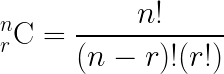
where,
- n = Number of Elements
- r = Number of Elements to be selected
- n >= r
For example:
(a+b)4 = 4C0a4b0 + 4C1a4-1b1 + 4C2a4-2b2 + 4C3a4-3b3 + 4C4a4-4b4
(a+b)4 = a4 + 4a3b + 6a2b2 + 4ab3 + b4
Algorithm for Binomial Theorem Python
- Declare a Function.
- Inside the function, take the coefficient of a and b and the power of the equation, n, as parameters.
- Calculate the first term by raising the coefficient of a to the power n. Subsequently, append it to the series list.
- Calculate the next term inside a for loop using the previous term. Use the formula mentioned below.
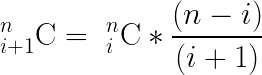
- Format and Append the next term to the series list.
- Convert the list to a string and print it.
We can implement an extra inner function for the formatting of the terms which would contain many if-else clauses. These clauses will decide how the terms will be formatted.
Python Code: Print the Binomial Series
def form_series(co_a, co_b, n):
    """
    This method creates the Binomial Theorem Series.

    :param co_a: coefficient of a
    :param co_b: coefficient of b
    :param n: power of the equation
    :return: None
    """
    def formatting(next_term, coeffs):
        """
        This is an inner function which formats the
        terms of the binomial series.

        :param next_term: coefficient of next term
        :param coeffs: powers of a and b
        :return: formatted term
        """
        if next_term == 1:
            coeffs.insert(0, "")
        else:
            coeffs.insert(0, next_term)

        if coeffs[1] == "^0" and coeffs[2] == "^0":
            return coeffs[0]
        elif coeffs[1] == "^0":
            return "{}b{}".format(coeffs[0], coeffs[2])
        elif coeffs[2] == "^0":
            return "{}a{}".format(coeffs[0], coeffs[1])
        elif coeffs[1] == "^1" and coeffs[2] == "^1":
            return "{}ab".format(coeffs[0])
        elif coeffs[1] == "^1":
            return "{}ab{}".format(coeffs[0], coeffs[2])
        elif coeffs[2] == "^1":
            return "a{}b".format(coeffs[0], coeffs[1])
        return "{}a{}b{}".format(coeffs[0], coeffs[1], coeffs[2])

    # Initializing a list named as `series`
    series = list()

    # Calculating the First Term, Formatting it
    # and Appending it to our Series
    first_term = pow(co_a, n)
    coeffs = ["^" + str(n), "^0"]
    series.append(formatting(first_term, coeffs) + "  +  ")

    next_term = first_term

    # Calculating, Formatting and Appending
    # the remaining terms.
    for i in range(1, n + 1):
        # We can find next term using the
        # previous term and the formula
        # mentioned below.
        next_term = int(next_term * co_b * (n - i + 1) / (i * co_a))

        # Pre-formatted list creation
        coeffs = ["" if x == 1 else "^" + str(x) for x in [n - i, i]]

        # Append till last term is not reached
        if i != n:
            series.append(formatting(next_term, coeffs) + "  +  ")

        # Append the last term.
        else:
            series.append(formatting(next_term, coeffs))

    # Joining the series as a string and printing it.
    print("".join(series))


if __name__ == "__main__":
    # Taking inputs
    print("( a + b ) ^ n")
    co_a = int(input("Enter the coefficient of a: "))
    co_b = int(input("Enter the coefficient of b: "))
    n = int(input("Enter n: "))
    print("({}a+{}b)^{}  =  ".format(co_a, co_b, n),end=" ")

    # Calling the Function
    form_series(co_a, co_b, n)
Input:
Binomial Theorem Python
Output:

Thank you for devoting your valuable time reading this article. You may check out these other articles as well:
Really useful. Saved me some brain work. Python can be so very helpful for doing Maths stuff!