Add prefix or suffix to each element in a list in C++
 By Pritam Hande
In this tutorial, we will learn how to add prefix or suffix to each element in a list in C++. Before proceeding for implementation let’s first understand what do you mean by prefix and suffix.
Prefix: is an affix that is placed at the beginning of an entity in order to alter its meaning.
For example in the word “rematch” re is a prefix and match is an original entity.
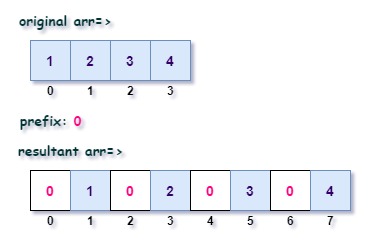
Suffix: is an affix that is placed at the end of an entity in order to alter its meaning.
For example in the word “strongest” est is a suffix and strong is an original entity.
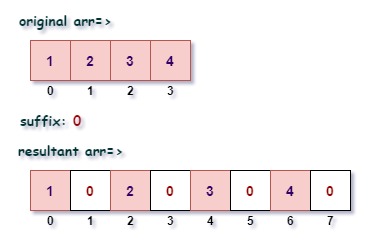
Program to add prefix or suffix to each element in a list in C++
#include<iostream>
#define MAX 100
using namespace std;

void add_prefix(int arr[], int n, int prefix)
{
  /* result will stored in array 'temp' */
  int temp[MAX],cnt=1;

  /* after adding prefix to each element size of resultant array will become 2n and loop will execute for index 0 to 2n-1 */
  for(int i=0 ; i<= 2*n-1 ; i++)
  {
    /* prefix will occupy even indices of the resultant array */
    if(i%2==0)
    {
      temp[i]=prefix;
    }
    else
    {
      /* element which was at index 'i-cnt' in original array will occupy index 'i' of the resultant array. */
      temp[i]=arr[i-cnt];
      cnt++;
    }
  }

  cout<<"\nResultant array after adding prefix to each element in an array: ";
  for(int i=0;i<=2*n-1;i++)
  {
    cout<<temp[i]<<" ";
  }
}

void add_suffix(int arr[], int n, int suffix)
{
  /* result will stored in array 'temp' */
  int temp[MAX];

  /* after adding suffix to each element size of resultant array will become 2n and loop will execute for index 0 to 2n-1 */
  for(int i=0 ; i<= 2*n-1 ; i++)
  {
    /* suffix will occupy odd indices of the resultant array */
    if(i%2==1)
    {
      temp[i]=suffix;
    }
    else
    {
      /* element which was at index 'i/2' in original array will occupy index 'i' of the resultant array. */
      temp[i]=arr[i/2];
    }
  }

  cout<<"\nResultant array after adding suffix to each element in an array: ";
  for(int i=0;i<=2*n-1;i++)
  {
    cout<<temp[i]<<" ";
  }
}

int main()
{
  int n, ch, arr[MAX],i,prefix,suffix;
  cout<<"Enter no. of elements of the list: ";
  cin>>n;

  cout<<"\nEnter elements of the list: ";
  for(i=0;i<n;i++)
  {
    cin>>arr[i];
  }

  cout<<"\n****menu****";
  cout<<"\n1) Add prefix to each element in a list";
  cout<<"\n2) Add suffix to each element in a list";
  cout<<"\nEnter your choice (1 or 2): ";
  cin>>ch;

  switch(ch)
  {
    case 1:
      cout<<"\nEnter prefix: ";
      cin>>prefix;
      add_prefix(arr,n,prefix);
      break;

    case 2:
      cout<<"\nEnter suffix: ";
      cin>>suffix;
      add_suffix(arr,n,suffix);
      break;

    /* Writing default case is not compulsory but it is a good programming practice. We can write default case anywhere in the switch block */
    default:
      cout<<"\nInvalid choice..!!";
  }

  return 0;
}
Input/Output (prefix):
Enter no. of elements of the list: 4
Enter elements of the list: 1 2 3 4

****menu****
1) Add prefix to each element in a list
2) Add suffix to each element in a list
Enter your choice (1 or 2): 1

Enter prefix: 0
Resultant array after adding prefix to each element in an array: 0 1 0 2 0 3 0 4
Input/Output (suffix):
Enter no. of elements of the list: 4
Enter elements of the list: 1 2 3 4

****menu****
1) Add prefix to each element in a list
2) Add suffix to each element in a list
Enter your choice (1 or 2): 2

Enter suffix: 0
Resultant array after adding suffix to each element in an array: 1 0 2 0 3 0 4 0
You may also read:
Leave a Reply